
How to Tell If Your Cast Iron Sewer Line Is Failing — A Venice FL Plumber Explains
If your home was built in Venice, South Venice, Nokomis, or Englewood before 1990, there’s a good chance your drain system is still running on its original cast iron pipes. And if it is, here’s what you need to know — that pipe is reaching the end of its service life right now, often without a single visible warning sign until it’s too late.
As a licensed Venice plumber who trains on a diagnostic-first approach, I’ve pulled enough corroded cast iron out of South Florida slabs to tell you this confidently: the pipe fails from the inside out. By the time a homeowner notices something wrong, the deterioration has usually been happening for years underneath their home.
What Cast Iron Looks Like After 45 Years in a Florida Slab
Earlier this year my crew performed a sewer camera inspection on a 1980 South Venice property. The homeowner had noticed one thing — a gurgling sound at the toilet whenever the washing machine and dishwasher ran at the same time. That was it. No backup. No odor. No slow drain. Just a gurgle.
The camera told a completely different story.
Inside the main 4-inch cast iron trunk line we found heavy black scale coating the interior walls, a belly — a low spot where wastewater pooled instead of flowing toward the septic — and debris accumulation blocking more than half the pipe’s usable diameter. The pipe walls themselves had corroded to near-collapse in several sections.
When we excavated and pulled that pipe out of the slab, this is what 45 years of Florida cast iron looks like:
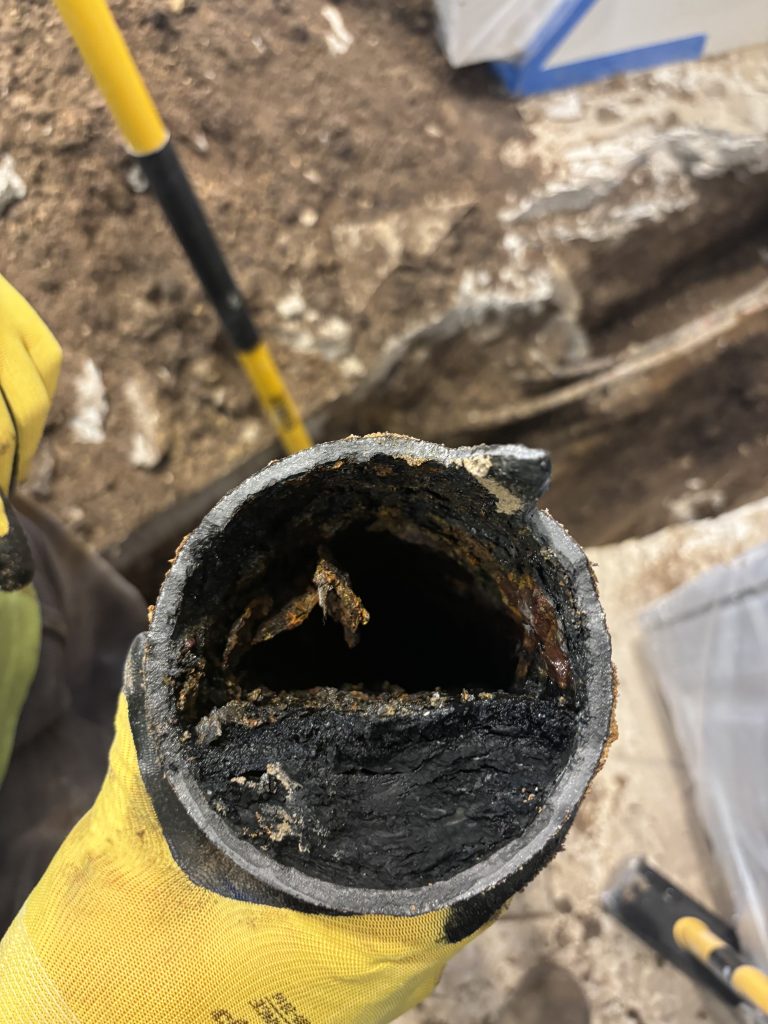
That pipe was months away from a complete failure and a sewage backup into the home. The homeowner had no idea.
Why Florida Accelerates Cast Iron Failure
Cast iron drain pipe installed in northern states often lasts 75-100 years. In South Florida slab construction the math is very different, and here’s why.
Florida’s humid subtropical climate keeps the soil surrounding buried pipes consistently moist. The region’s sandy, slightly acidic soil attacks cast iron from the outside while wastewater acids — from cleaning products, food waste, and normal use — attack from the inside simultaneously. Unlike homes built with crawl spaces or basements where pipes can be visually inspected, South Florida slab construction buries everything completely beneath concrete. You cannot see it, smell it, or detect it without a camera.
According to a 2023 study conducted by the Utah State University Water Research Laboratory, cast iron pipes fail at a rate of 28.6 breaks per 100 miles annually — nearly ten times the failure rate of modern PVC pipe at just 2.9 breaks per 100 miles. For Venice homeowners whose 1980s slab homes still run on original cast iron, that number hits close to home.
The 5 Warning Signs Your Cast Iron Line Is Failing
You don’t always get obvious warning signs, but when you do see these — take them seriously:
1. Gurgling at the toilet when other fixtures run This is the most common early symptom. When the washing machine, dishwasher, or another drain dumps a large volume of water quickly, it needs air to flow through the system. If there’s a belly or partial blockage in the main line, that rushing water creates negative pressure and pulls air through the toilet trap — causing the gurgle. This is exactly what the Sterling Road homeowner experienced.
2. Slow drains throughout the house — not just one fixture A single slow drain is usually a localized clog. When multiple fixtures throughout the home drain slowly at the same time, that points to a problem in the main trunk line — the pipe that carries everything to the septic or sewer.
3. Recurring clogs that come back weeks after clearing If you’ve had your drains snaked and the problem keeps returning within a few weeks or months, the snake is clearing debris but not fixing the underlying problem. A belly or collapsed section will keep collecting waste no matter how many times it gets cleared.
4. Sewage odors inside the home Cast iron that has cracked or separated at a joint allows sewer gas to escape into the soil and sometimes back into the home. If you smell sulfur or sewage and can’t find the source, it may be coming from beneath the slab.
5. Septic system recently replaced or serviced This one surprises homeowners. When a septic system is replaced, the excavation process disturbs the soil surrounding the buried drain lines. That ground movement can shift, crack, or displace cast iron pipe that was already weakened — creating a belly or joint separation that wasn’t there before the septic work. If your septic was recently replaced and you’re now noticing drainage issues, these two things are almost certainly connected.
Why Rain Season Makes It Worse
Sarasota County’s rain season runs June through September. During that period, saturated soil shifts and ground movement increases — putting additional stress on already weakened pipe joints. Heavy rainfall also increases the volume of water moving through drain systems rapidly, which stresses a partially blocked or bellied line in ways normal daily use doesn’t.
A cast iron line that is barely managing day to day can fail completely when rain season hits. We see it every year.
If your home was built before 1990 and you haven’t had a sewer camera inspection, scheduling one before June 1st is the single most important thing you can do to protect your home heading into storm season.
What a Sewer Camera Inspection Reveals
A professional sewer camera inspection runs a camera through your entire main drain line from the toilet flange to the septic tank or municipal connection. You watch the footage in real time on a screen. There is no guessing, no digging blind, and no surprise discoveries mid-project.
The camera identifies the exact location of any belly, blockage, crack, joint separation, or root intrusion — to within inches. A locator device then pinpoints the problem area on the surface above, so if excavation is needed we cut precisely where the problem is and nowhere else.
At Plumbing Detectives LLC every inspection includes a full camera run of the main trunk line, real time viewing for the homeowner, and a complete documented assessment of pipe condition. If we find a problem we show it to you on screen before we ever discuss a repair.
When Camera Inspection Leads to Sewer Line Repair
If the camera reveals a belly, significant scale buildup, cracked joints, or corrosion that has compromised the pipe walls, the next step is sewer line repair or replacement. For most Venice slab homes this means excavating the affected section, removing the failed cast iron, and installing new Schedule 40 PVC at correct pitch and grade.
Modern PVC doesn’t corrode. It doesn’t develop scale buildup the way cast iron does. And installed correctly at proper pitch it will outlast the home itself.
The Sterling Road homeowner had approximately 50 linear feet of cast iron trunk line replaced — from the first bathroom group through the kitchen and out to the septic. Every branch connection was rebuilt with new PVC wyes and no-hub couplings. The camera ran through the completed line before we closed anything up, confirming proper pitch and full flow throughout.
That homeowner now has a drain system that will perform for decades. The gurgling is gone. The risk of a sewage backup is gone. And they know exactly what’s under their slab.
Is Your Venice Home at Risk?
Your home is most likely to have a failing cast iron system if it was built between 1970 and 1990 on a concrete slab anywhere in Venice, South Venice, Nokomis, Osprey, Englewood, or North Port. If your septic system has been replaced in the past five years, that risk increases significantly.
The diagnostic is simple, fast, and gives you complete information before any decision is made.
Plumbing Detectives LLC is currently scheduling sewer camera inspections throughout Sarasota County ahead of the June 1st rain season.
📞 239-388-3631 🌐 plumbingdetectivesfl.com License CFC1434139